Performance, reliability, and responsiveness: The triad of Customer Success in high-stakes industries
In finance, logistics, and maritime, one truth stands out: your ability to respond to customers is only as strong as the performance and reliability of your systems.
When we talk about customer success, responsiveness is often framed as a front-line function: how quickly support replies, how empathetic account managers are, how transparent communication feels. These things matter. But in high-stakes environments - where ships worth hundreds of millions need clearance, or millions of dollars trade hands in seconds - responsiveness is the visible tip of a much larger iceberg.
Beneath the surface lies performance and reliability: the speed, accuracy, and consistency of the systems that customers depend on. If they fail, no amount of frontline charm can make a business appear responsive.
The triad: Performance, reliability, responsiveness
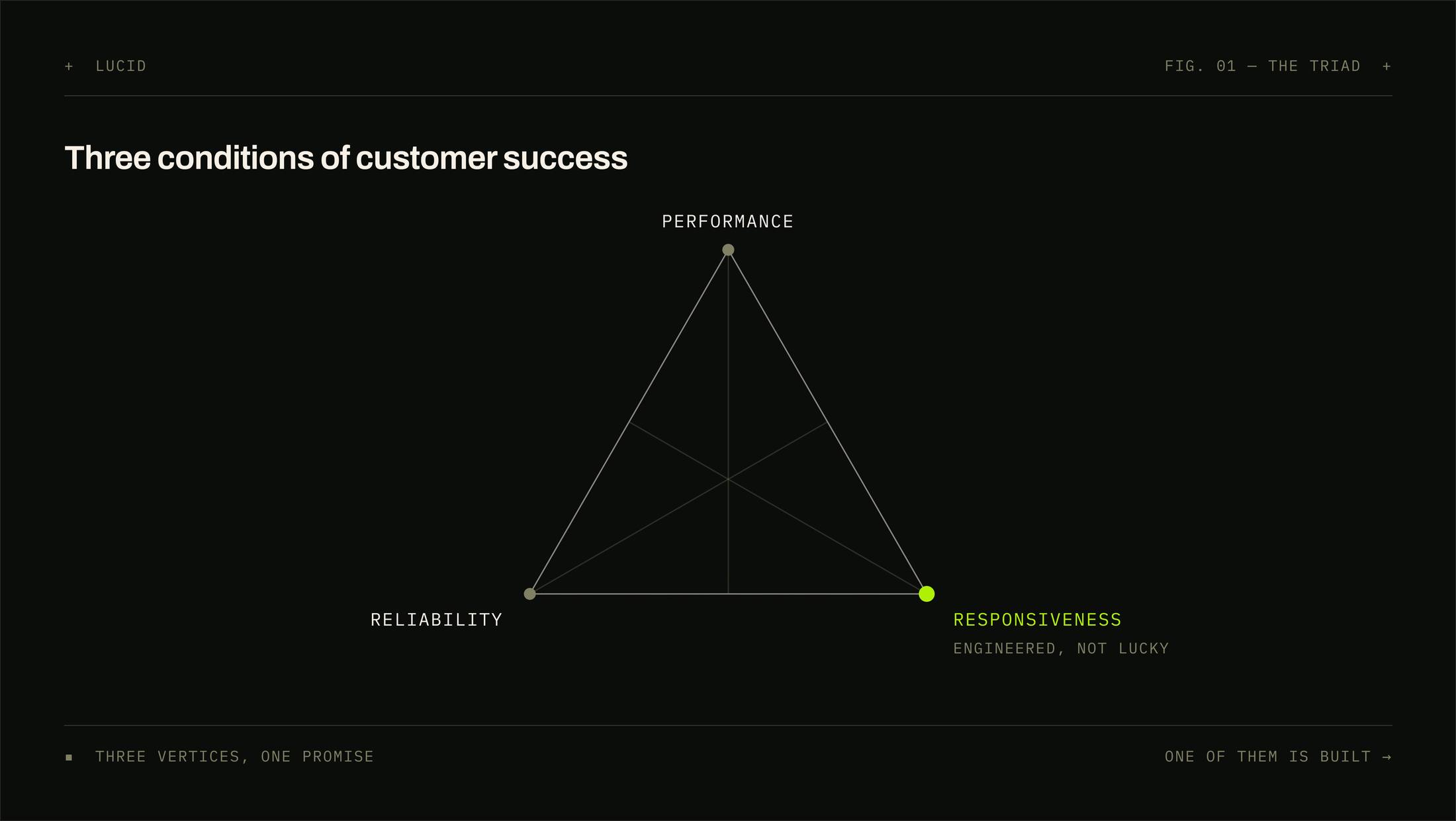
Think of customer success as a three-legged stool:
- Performance: Fast, accurate, and smooth service.
- Reliability: Consistency, uptime, and availability.
- Responsiveness: The ability to address needs and resolve issues quickly.
If performance or reliability falters, responsiveness collapses with it. A customer waiting three hours on hold isn’t really angry about the hold music - they’re angry because your system was too slow, or down, or unreliable in the first place.
Modern service leaders define these dimensions together. Availability and reliability create the conditions for responsiveness. Performance determines whether a customer feels your business is agile or sluggish. Responsiveness, in turn, shapes the trust that drives retention.
High-stakes examples: When the triad breaks down
In low-stakes contexts - say, a streaming service - customers will grumble about outages but tolerate them. In high-stakes industries, the costs are far greater.
- Banking: In October 2024, Bank of America experienced an outage that briefly showed some customers blank or $0 balances, prompting widespread concern before service was restored. In the UK, TSB’s 2018 IT meltdown locked 1.9 million customers out of their accounts, costing £330 million and prompting 80,000 customers to switch providers.
- Global Logistics: On July 19, 2024, a faulty CrowdStrike update triggered the largest IT outage on record. Airlines canceled thousands of flights (AP tallied ~2,000 U.S. cancellations by midday; later estimates put the global total near 5,000). Some port terminals reported IT issues; impacts ranged from brief delays to queues at gates.
- Maritime: In 2017, the NotPetya ransomware attack crippled Maersk’s IT globally. Port operations fell back on Post-it notes and WhatsApp. It took two weeks to recover, costing $200–300 million and eroding customer confidence. Maersk Line volumes fell by ~2.5% that quarter as customers shifted to competitors.
- Manufacturing: In August 2023, a system glitch (not a cyberattack) halted all 14 Toyota assembly plants in Japan, affecting around 13,500 vehicles per day of output. Even with rapid recovery, the ripple effect highlighted the fragility of just-in-time operations.
Each of these cases shows the same pattern: a reliability or performance failure cascades into an inability to respond. Customers don’t see systems—they see unresponsiveness.
The engineering link: Why reliability is a Customer issue
Responsiveness isn’t just a support metric. It is the output of engineering excellence.
- Code quality and testing reduce defects that cause downtime. High-quality software equals smoother customer experiences.
- CI / CD pipelines minimise deployment risk, allowing fixes and features to ship continuously without compromising stability.
- Observability ensures teams see problems before customers do, enabling proactive responsiveness.
- Incident management with clear runbooks and proactive communication keeps customers informed - vendor research suggests this can reduce complaints by ~40% and increase satisfaction by ~85%.
- Resilient architecture - redundancy, failover, graceful degradation—keeps systems usable even when parts fail.
- DevOps and SRE practices (error budgets, blameless post-mortems, shared ownership) embed reliability into culture. Elite teams restore service in under an hour, compared to days or weeks for laggards.
In short: customer responsiveness is engineered, not improvised.
Why this matters: Happiness, engagement, retention
The downstream effects are stark:
- Customer happiness: Reliability failures breed frustration and anxiety. In banking, 34% of customers admit they worry about IT outages. Consistent uptime, on the other hand, builds deep trust.
- Engagement: A fast, reliable system invites deeper usage. A slow, unreliable one drives customers to workarounds - or competitors. Industry studies report that even a 1-second delay can cut satisfaction by ~16%, and ~64% of users who have a poor speed experience are less likely to return.
- Retention: Reliability failures directly trigger churn. Maersk lost volumes after NotPetya; TSB lost 80,000 customers. Meanwhile, companies that deliver consistently see higher renewal, upsell, and advocacy.
Building the triad: Recommendations
To strengthen the link between engineering and customer success, organisations should:
- Elevate reliability as a first-class feature. Treat uptime and performance as product capabilities, not background chores.
- Invest in resilient design. Build for failure with redundancy, isolation, and graceful degradation. Test regularly with chaos engineering.
- Adopt modern engineering practices. CI / CD, automated testing, observability, and SRE frameworks reduce failure rates and speed recovery.
- Communicate proactively. Keep customers informed during incidents; honesty builds trust faster than silence.
- Align incentives. Tie engineering KPIs (uptime, MTTR, change failure rate) to customer success KPIs (NPS, churn, lifetime value).
Conclusion: Responsiveness is reliability
In high-stakes industries, responsiveness isn’t about being nice on the phone. It’s about whether your systems work when they’re needed most.
Performance and reliability are invisible until they fail - then they become everything. Customers don’t care about the complexity of your stack; they care that their cargo sails, their money moves, their supply chain runs.
When performance is high and reliability strong, responsiveness feels effortless. When either falters, responsiveness collapses and trust evaporates.
The companies that win will be those that engineer responsiveness into their DNA - treating reliability not as a cost, but as the most important feature they deliver.
Sources
- Bank outages: Bank of America (Oct 2024), TSB migration failure (2018)
- Global outages: CrowdStrike update (July 2024)
- Maritime: Maersk / NotPetya (2017)
- Manufacturing: Toyota plant glitch (Aug 2023)
- Engineering performance: DevOps MTTR metrics
- User experience stats: Page load & customer return rates
- Proactive comms: Vendor research (nShift)