We weren’t building a better inbox. We were building TradeOS
The operating system for global trade.
When I joined Sedna as Head of Strategy, I wasn’t just trying to define a roadmap. I was trying to define reality.
In any early-stage company - especially one tackling a space as entrenched as email - you’re constantly at risk of mistaking iteration for innovation. So we paused. We looked inward. We asked the hard question:
What category are we really here to create?
That led to one of my first projects: a body of research and analysis designed to name the problem we wanted to own and the space we aimed to lead. We called it “Intelligent Communication Systems.” It was the product of dozens of customer interviews, ecosystem benchmarking, and internal workshops. And it produced a core insight: email wasn’t broken because it was outdated. It was broken because it had become misaligned with how business actually happens.
The blog post that followed captured that thesis. It was raw, early, and imperfect—but directionally right. Because while it talked about email, what it really talked about was something deeper:
The need for a shared system of intelligence for global work.
We thought we were designing a category. What we were really doing was laying the foundation for an operating system.
What we believed
The original post made three bold claims:
- Email, though essential, was actively creating drag in complex, collaborative work.
- Most B2B tools were layering features onto a broken foundation rather than solving the root issue.
- What was needed was not a “better inbox,” but a systemic redesign: a workspace that thinks and works like the teams using it.
We framed that vision as an Intelligent Communication System - something that moved beyond siloed threads and duplicated effort, and toward a single source of structured, contextual truth.
At the time, this felt like category design. Looking back, it feels like the first articulation of TradeOS.
What we’ve built
Fast forward to today: Sedna has become the connected nervous system for high-volume communication and collaboration in global trade. That evolution has been grounded in several core innovations:
AI-categorisation (Augur): What began as smart tagging evolved into a semantic operating layer. Augur doesn’t just classify data - it connects it. Across messages, tags, counterparties, and systems, Augur transforms email into structured operational intelligence.
Pulse: Built on Augur’s foundation, Pulse gives teams real-time situational awareness. It turns millions of emails into insights - surfacing trends, anomalies, and risks with the speed and clarity required for high-stakes decisions.
Apps & APIs: Sedna is no longer a single app. It’s a platform. Infrastructure, with AI at its core. Our open APIs and app framework allow customers to embed their business logic, workflows, and integrations directly into Sedna - turning it into a programmable operating layer for every team and partner.
Networked collaboration: This is where the original ICS vision achieves escape velocity. Sedna connects not just internal teams, but external partners across companies - creating a shared workspace where messages, documents, and workflows move together in real time. Collaboration becomes not just easier, but automatic.
The TradeOS strategy
Today, this vision has a name: TradeOS.
TradeOS is our answer to the structural problems of global trade. It’s not a dashboard. It’s not another inbox. It’s a new foundation for how work flows:
- A unified platform for data, decisions, and documentation
- A shared infrastructure for counterparties across the trade lifecycle
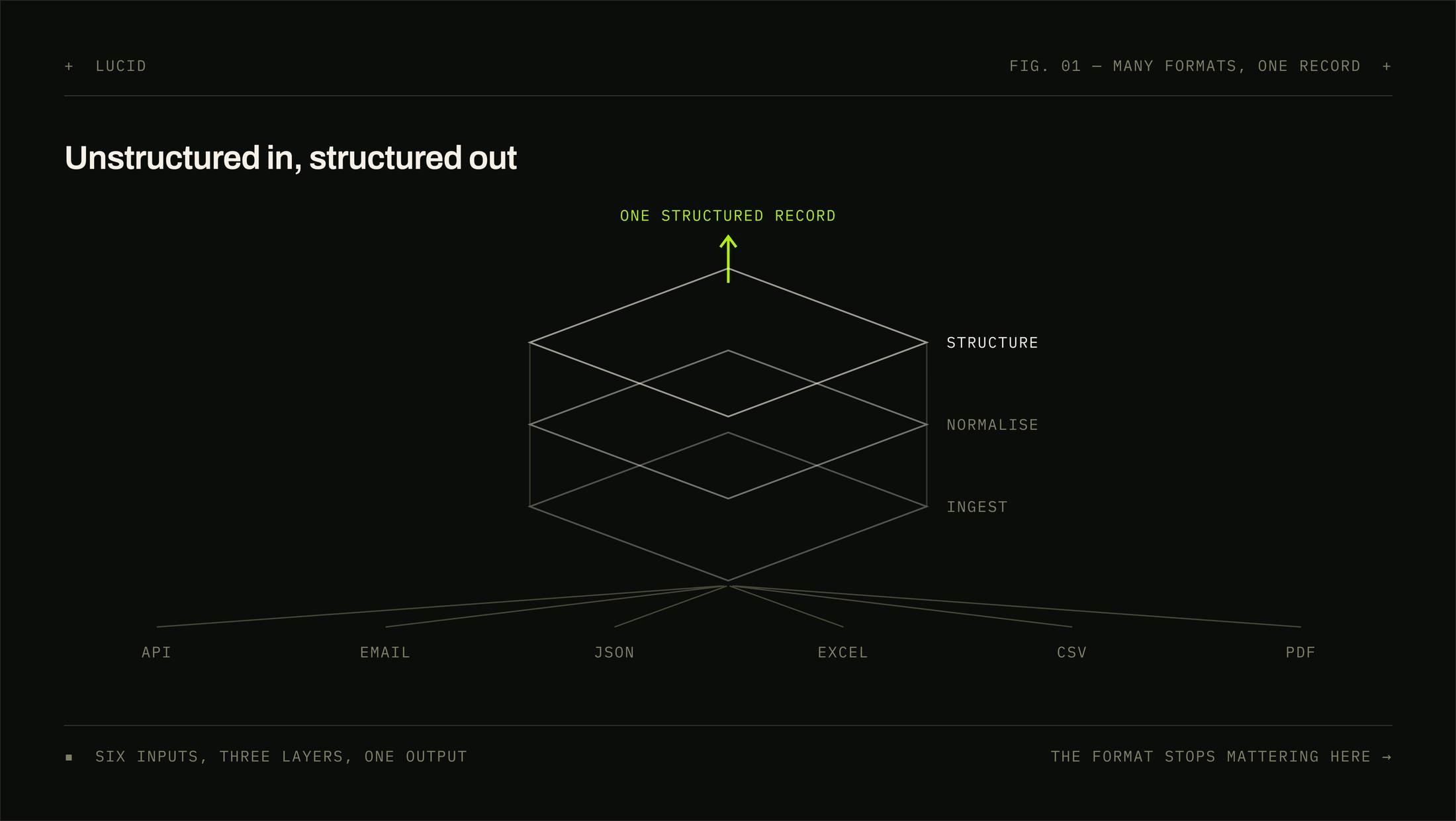
- A system that transforms unstructured communication into executable insight
TradeOS bridges the gap between communication and coordination. It doesn’t replace email - it transcends it. It makes email part of a system, not the system.
Just as the iPhone reimagined phones by embedding them into a networked ecosystem of apps, sensors, and services, TradeOS reimagines enterprise communication as a system for shared context and structured execution.
Our acquisition of Dataloy is a cornerstone in this evolution. Their voyage management system and structured data model extend our platform into the planning and execution layers of trade. With Dataloy, TradeOS gains a deep operational anchor - linking what’s communicated with what’s actually happening across the voyage lifecycle.
This integration makes it possible to align fixtures, charters, port calls, and documentation across every stakeholder in the network. It gives the industry a single pane of glass - and the intelligence to act.
The throughline
What’s most striking isn’t how much our thinking has changed - it’s how much it’s held. The core belief that started all this still drives us:
Product evolution solves product problems. But product innovation addresses human ones.
That’s what TradeOS does. It reduces complexity. It aligns intent and execution. And it turns fragmented workflows into a coordinated, intelligent system.
Dataloy doesn’t just plug into this vision - it amplifies it. With structured voyage data flowing into Sedna, we’re building something rare in enterprise software: an environment where communication and execution are meaningfully synchronised.
The result? Faster turnarounds. Fewer handovers. Higher trust. Shared context - at scale. What began as a hypothesis about email has matured into a strategic infrastructure for the future of global trade.
What’s next
We’re just getting started.
The next phase of TradeOS includes:
- A growing ecosystem of native and third-party apps
- Deeper AI support across categories like laytime, claims, and emissions
- A unified design language that prioritises action, not information overload
And with Dataloy fully integrated, we’re not just enabling visibility - we’re enabling velocity. Operational events will trigger workflows. Structured data will drive automation. And teams will be able to manage exceptions, not just transactions.
If you’re a customer, this means faster time-to-value. If you’re a partner, it means new opportunities to build on the TradeOS stack. If you’re watching from the sidelines - now’s the time to lean in. Because this isn’t just a product strategy. It’s the architecture for a new category.
We weren’t building a better inbox. We were building the operating system for global trade.
Read the original post below.
Written in 2020, first published in 2021.
Hands up if you were a Walkman user (for any Gen Z readers, this was the Rosetta Stone of
portable music). At the time, they were totally revolutionary. And would end up being the catalyst for a decades-long case study on how true innovation is often inspired by human behaviour.
It’s a journey you may have personally joined. Once Sony democratised on-the-go listening, it was ripe for optimisation and a market that—both consciously and unconsciously - demanded progress. Portable cassette players became portable CD players. Music downloading software and CD burning introduced customisable playlists (and a few lawsuits). MP3 players offered greater and more convenient song storage. Then Apple busted through the wall Kool-Aid style and said, “Oh yeah, we’ll take it from here.”

In the most reductive terms, Apple’s focus on the whole user experience—and the consolidation and integration of technology with human psychology - is what’s made one of the most successful lines of products in modern history. And ultimately opened the door to a level of interconnectivity that’s shaped modern life as we know it.
The iPod, with its sleek design, unrivalled storage, and relatively seamless merging of hardware and software via iTunes went beyond a “better MP3 player.” It created an elevated experience that solved the practical problems of previous technology while catering to intangible human desires. Intuitive user flows, less cognitive load, and a need to have something naturally align with and augment existing behaviour - instead of injecting more process into it - was a holistic solution that sparked a cult-like following and steamrolled the asphalt for our eventual ability to access everything, music included, in the palm of our hand.
From iPod to iPhone - and a suite of products working in tandem - Apple famously revolutionised how we listen to music before extrapolating that into a fully-integrated network that’s become something of a shared lifestyle. While the iPhone wasn’t the first smartphone on the market, it was the most influential, for the same reasons the iPod became the go-to portable listening device and the runway it created. Apple’s ingrained position as the “nervous system” of many people’s technological lives shows just how powerful that experiential understanding is.
All that to say - while product evolution solves product problems, product innovation solves human problems. And business communication is in desperate need of innovation.
While email solved one problem, how we use it has created others
Email was just as revolutionary as the nascence of digital communication. Built in 1965 as “MAILBOX,” it was created for MIT students to leave messages on campus computers. The ability to send messages from one computer to another, and what would become the foundation of the Internet, came just a few years later. Fast-forward to current day when over 3.9 billion users and 5.9 billion email accounts are active across the world. It’s email’s ubiquity and easy access that’s made it the default system for digital correspondence.
But as the phrase “my work email” quickly implanted in our general lexicon, the experience of email has remained largely personal. Email is individualised at its core, with siloed inboxes, self-maintained organisation, and contextual opacity that has unintentionally created real problems for organisational and team-based communication. Tons of B2B software companies have emerged over the years to try and solve these problems - chat services, collaboration tools, video conferencing - but are often supplementary to email’s communicational linchpin.
These problems don’t need additional tools or a “better” version of the same one. They need a holistic solution that tackles the root cause and organically improves their working experience - an intelligent communication system that’s designed for business workflows.
Email problem 1: Unnecessary duplication of effort
The “cc effect” and Sisyphean nature of email is so universally understood, it’s reached #relatablecontent status.

Forwarding, cc-ing, and reply-alls not only bloat email volume - creating an insidious psychological burden as well as a measurable tax on server capacity - they’re a direct result of private, individual inboxes that create conversational partitions. The complexity of information being shared via email, and the decision-making process and actions associated with it, often have to be reiterated and over-explained to make up for information being unintentionally hoarded in Stuart’s one-on-one thread with JoAnne. This context deficit and manual rerouting causes an unnecessary duplication of effort.
Email problem 2: Hindrance to collaboration
In the same vein, a lack of transparency makes it difficult to effectively collaborate within and across teams. When information isn’t readily available and teams are denied a single, accessible source of truth for a project, transaction, conversation - whatever they need to be fully informed to do their best work - its effects reverberate throughout the organisation and eat up valuable time searching for answers. The sheer amount of communication, data, and average workload modern-day businesses and employees manage is more than traditional email was ever designed to handle, let alone facilitate. Increased transparency, comprehensive context, and on-demand access to important information is what’s really important to working smarter.
Email problem 3: Inefficient workflow compensation
We’re not talking about that type of compensation, though employees could be entitled to some extra cash considering the amount of extra work individualised email triggers. Problems one and two typically lead to custom workflows, bespoke processes, manual organisation, and a growing technology stack of piecemeal third-party solutions for symptoms of the core issue. Approaching these problems from a high level - integrating scalable remedies with workflows guided by human behaviour instead of struggling to change it - means less confusion, more action, increased efficiency, and ultimately, more time and room in your budget for the work that matters.
The solution: Intelligent Communication Systems designed for businesses
Just as Apple took the entire user experience into account, business communication systems must do the same for the organisation and employee experience. Innovative solutions to the problems listed above won’t come from fancy-sounding features or improved versions of the same fixes - they’ll come from an innate, deliberate effort to redefine and optimise how teams communicate and work together. For right now, and for the future ahead.
We need a way of communicating that breaks free of existing organisational structures and the limitations of legacy systems. “Intelligent” isn’t (just) a buzzword - the next generation of communication systems will listen and adapt to human behaviour, offering and providing access to the most relevant information and learning to anticipate their needs. They’ll be reliable, secure, and fast - no matter the circumstances. They’ll provide necessary context and historical reasoning for things that have happened, decisions that have been made, and how things are connected, working smarter as time goes on.
Intelligent communication systems will help employees be more efficient and more effective, aligning teams around behavioural action, and unifying all conversations, data, and documentation to help teams focus on what matters most.