Why fractional works, and the three cases where it doesn't
Fractional leadership is a leverage instrument, and leverage only multiplies what's already there.
Most companies buy fractional leadership as a discount. Two days a week of someone they couldn’t afford for five. It’s an understandable way to think about it, and it’s the reason so many of these engagements end politely and change nothing.
Last time I argued that the operating model is the product decision nobody writes down. Who decides, how fast decisions travel, what “done” actually means, who’s allowed to kill something. Most companies inherit all of it and author none of it.
If you accept that, the follow-on question is a practical one. Who changes it?
The answer isn’t more people. Headcount doesn’t rewrite an operating model, it just runs harder inside the one you’ve already got. What changes it is someone who has done it before, in a company close enough to yours that the pattern transfers.
That’s the actual case for fractional, and it has very little to do with cost. You’re renting judgment and pointing it at the layer that determines everything downstream of it.
You're not buying days. You're buying decisions.
The day rate is packaging. What transfers in a good engagement is a set of decisions somebody has already got wrong somewhere else, at their own expense, and has no intention of repeating.
Where prioritisation actually lives. What “done” means, defined tightly enough that two people can argue about whether something is. Which calls need a room and which need one person with the authority to make them. How fast a bet gets killed once the evidence is in. Whether product, engineering and commercial have a real interface or just a shared Slack channel and good intentions.
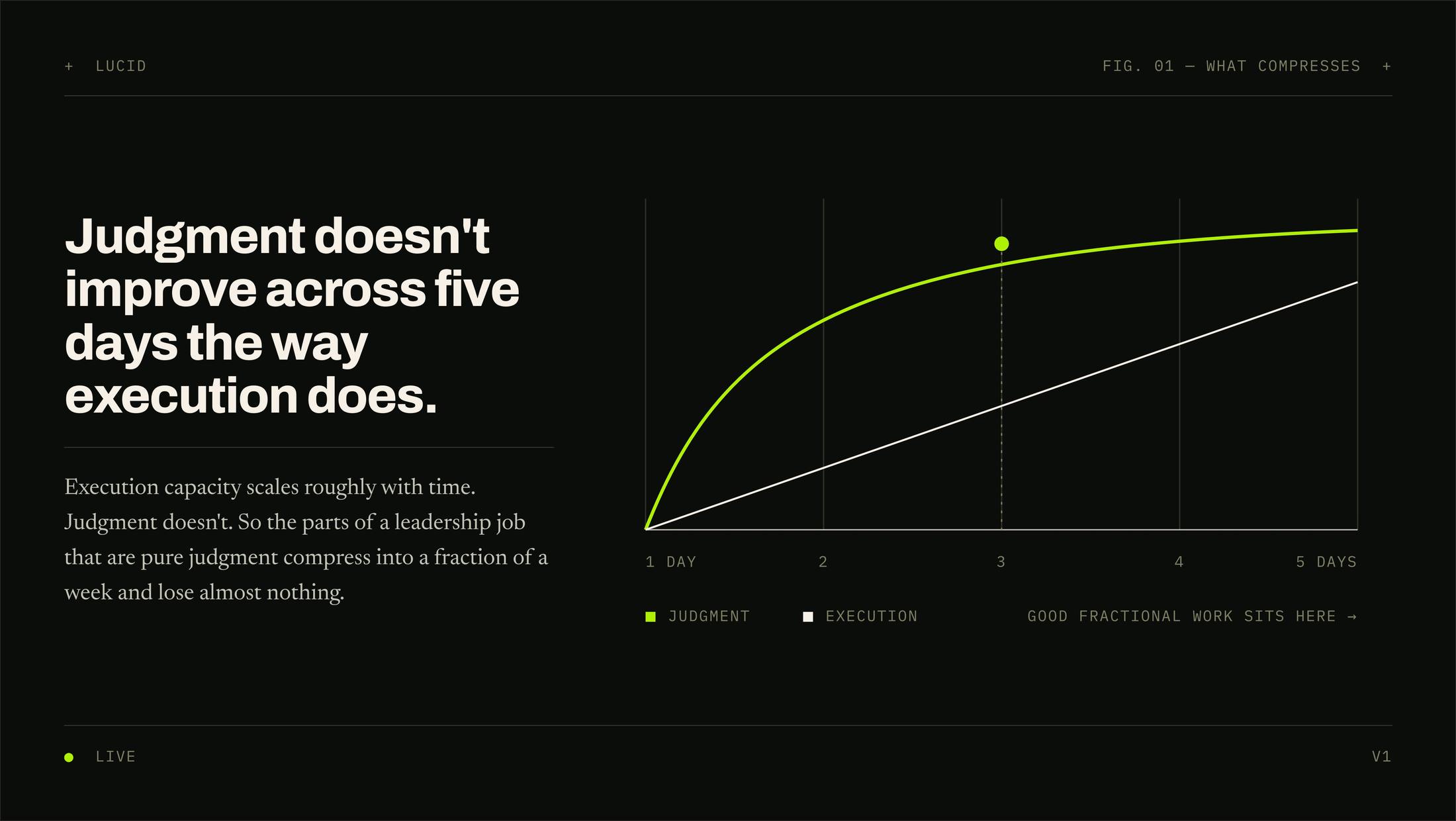
Execution scales with hours. Judgment mostly doesn’t. Which is why the judgment-heavy parts of a leadership job survive compression into two days a week more or less intact, and the parts that are throughput or presence don’t survive it at all.
Good fractional work sits on one side of that line. Every failure I’ve watched sat on the other.
One: the gap is capacity, not judgment
This is the common misdiagnosis, and an expensive one.
The team feels slow. The roadmap slips twice in a quarter. The board starts asking a sharper class of question. So the company goes looking for a fractional CPTO to come in and sort out product and engineering.
Except sometimes there’s nothing wrong with the thinking. Everyone knows what to build, the prioritisation is defensible, and the real situation is five engineers carrying a roadmap scoped for twelve, no QA, and a release process that eats most of a Thursday.
Put a fractional leader into that and you’ve added a decision layer to a team that didn’t have a decision problem. I watched a Series A company do exactly this. Six months in they had the sharpest product strategy in their category and the same release cadence they’d started with. The strategy was good. It was just never the thing stopping them.
If you can already name the decision and simply can’t get it executed, that’s a capacity problem, and no amount of senior thinking closes it. Hire the hands, or cut the scope. Both are cheaper than paying a premium for clarity you already had.
Two: there’s nobody to install it into
Fractional work only compounds if it lands in a person.
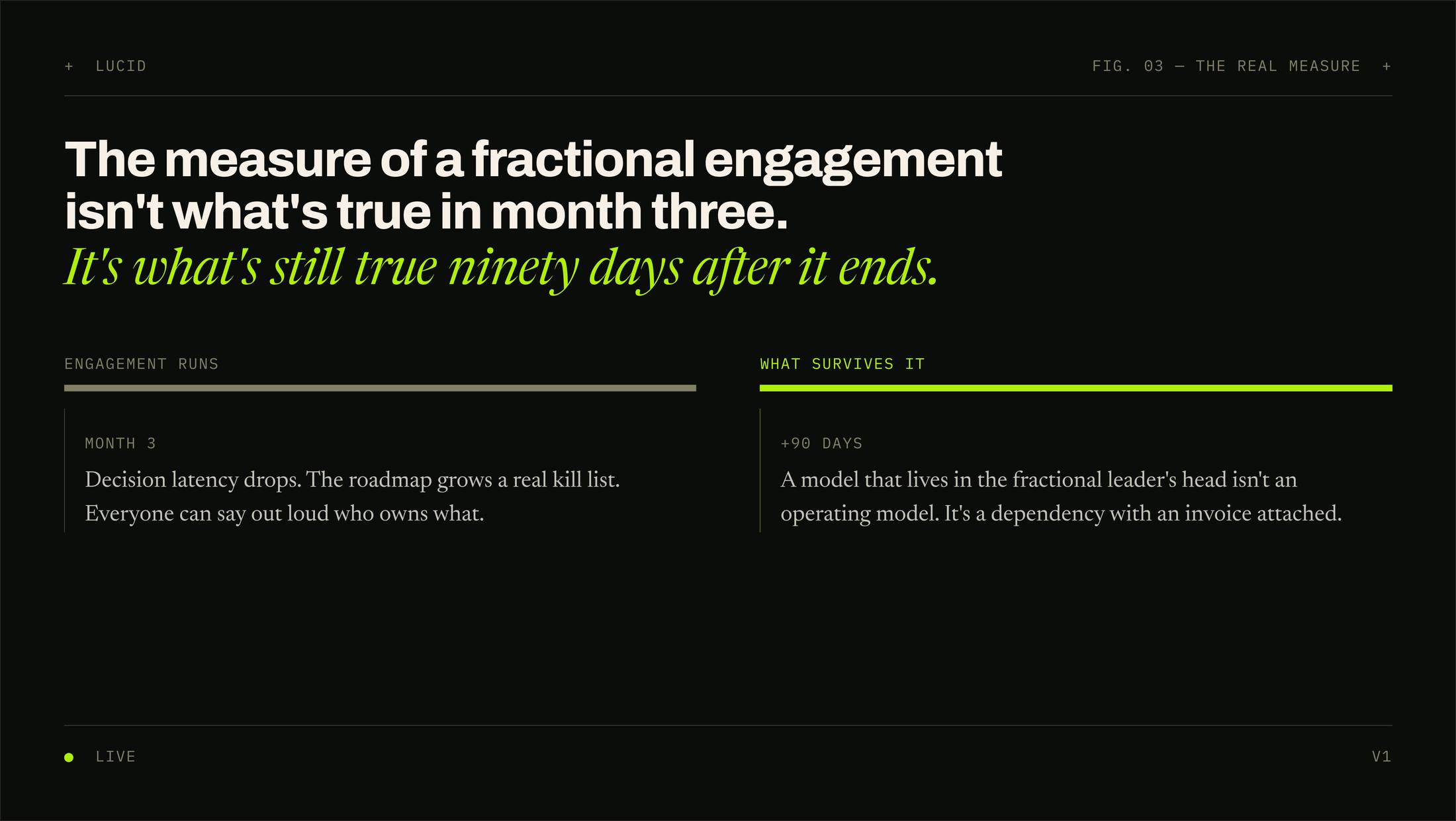
A model that lives in the fractional leader’s head isn’t an operating model. It’s a dependency with an invoice attached.
I’ve seen this go wrong in a way that’s genuinely hard to spot at the time, because on every visible measure the engagement worked. Decision latency dropped from weeks to days. The roadmap grew a real kill list. People could say out loud who owned what. Then the engagement ended, and inside a quarter most of it had quietly unwound.
Nothing about the model was wrong. It lived in one person’s calendar, and when the calendar went, it went with it.
So the measure worth using isn’t what’s true in month three. It’s what’s still true ninety days after the last invoice.
Which makes the day-one question less interesting than it looks. Not what will change, but whose job this becomes. A VP who owns the cadence. A founder who keeps kill authority instead of handing it straight back the first time it’s uncomfortable. Someone whose name goes on the model when yours comes off.
If you can’t name that person, you’re not buying a model. You’re renting a spine.
Three: the role is founder-shaped, or the building is on fire
Some jobs need one person, present, all of the time.
A turnaround. A fundraise that’s genuinely in doubt. A launch the company has bet itself on. Any role where the person is the public face, and their continuity is itself the message to customers, staff and investors.
Crisis is the clearest version of it. Fractional leadership runs on cadence: a weekly rhythm, defined review points, decisions batched to the place they belong. Crisis takes cadence apart. It compresses decision cycles down to hours, and it wants someone who was in the room for the last three of them rather than someone reading a summary on Tuesday morning.
A lot of it is simply presence, too. Being there on the bad day isn’t a deliverable you can schedule. When a company is frightened, people read the calendar as a statement of commitment, and they aren’t wrong to read it that way.
Fractional can advise a crisis. It shouldn’t own one.
What the three have in common
None of these are arguments that fractional is bad. They’re cases where the thing actually constraining the company isn’t the quality of its decisions.
Leverage only multiplies what’s already there. Point it at a capacity problem and it multiplies nothing. Point it at a need for presence and it does worse than nothing, because part-time attention on a full-time problem reads to everyone else as absence.
It’s the same error companies make with tooling. New system, broken process, and now you get to the wrong answer sooner.
Three questions before you hire one
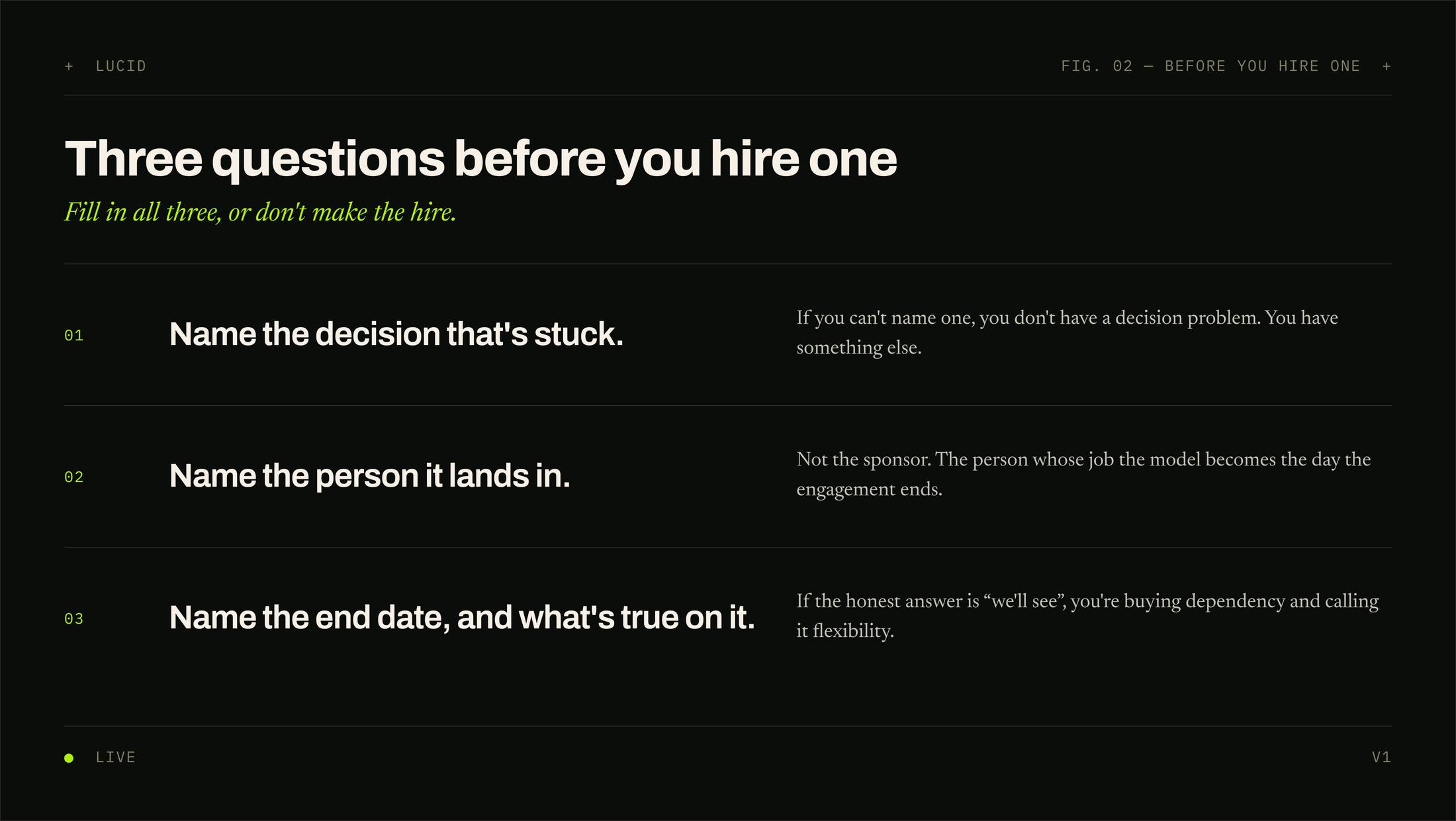
The stuck decision. If you can’t point at one, you probably don’t have a decision problem, and it’s much cheaper to find that out now than in month four.
The person it lands in. Not the sponsor who signs the contract. The one whose job the model becomes on the day the engagement ends.
The end date, and what’s true when you reach it. If the honest answer is “we’ll see”, you’re buying a dependency and calling it flexibility.
Get all three and fractional is one of the highest-leverage moves available to a company your size. Miss one and you’ve bought a very well-argued quarter that evaporates on contact with the next one.
Why this gets more important, not less
As AI takes the cost out of execution, the ratio shifts. Companies need fewer hands and better decisions, which makes the first failure case rarer and the underlying argument for fractional stronger than it was five years ago.
It also makes the second one more dangerous. Leaner teams mean fewer people to install a model into. Judgment gets cheaper to rent and harder to leave behind. That’s the tension I’d watch over the next few years. Not whether fractional works, but whether what it builds survives contact with a smaller org chart.
It’s the same question I ask myself before taking anything on. If I can’t see who the work lands in, I’d rather say so at the start than bill through it and hope.
So before your next fractional hire, write the three lines down. The stuck decision, the person, the date. If you can’t finish all three, the hire isn’t the first problem to solve.
What’s the best or worst fractional engagement you’ve watched up close? Hit reply and tell me what actually made the difference.